
Last updated September 20, 2026
Free on-site gate assessment - hinges, posts, and your LiftMaster or Nice gate operator checked before anything is quoted
The assessment is free and the quote is the invoice.

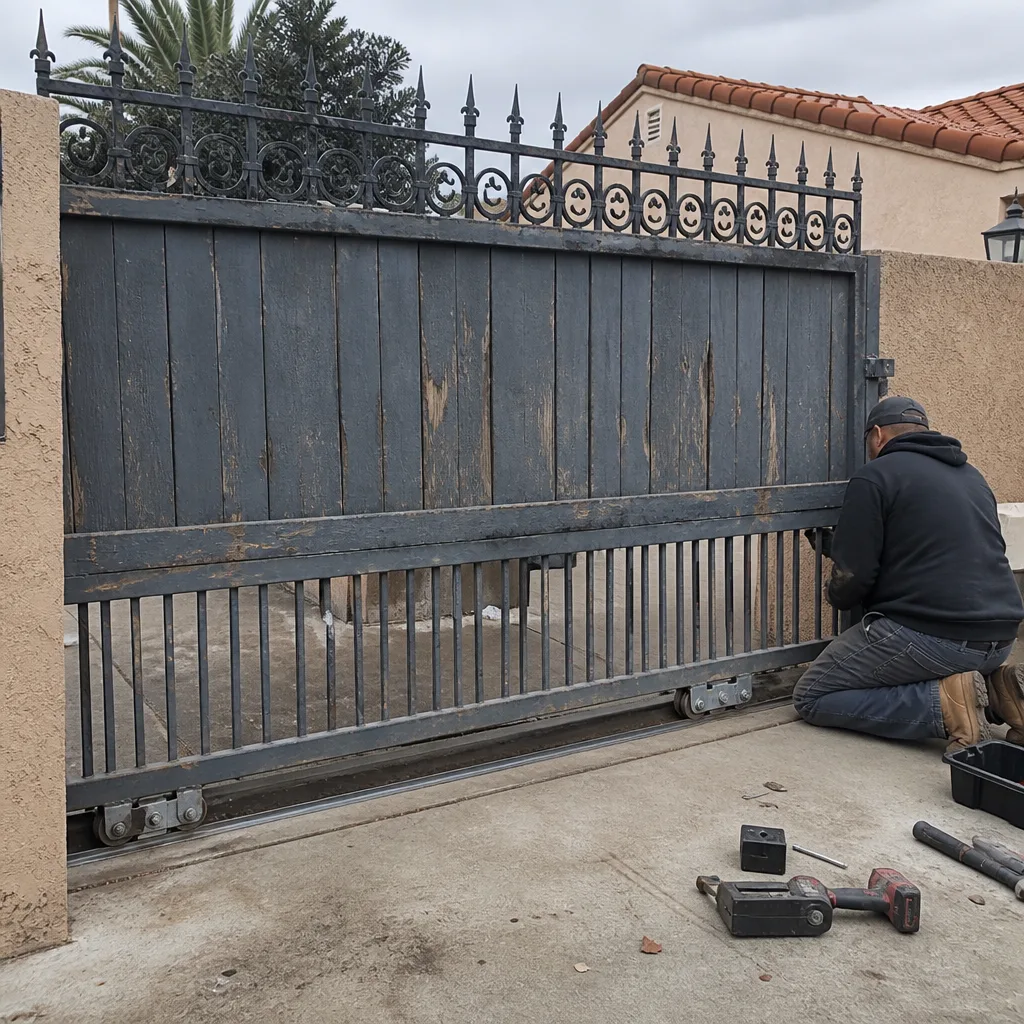 Before
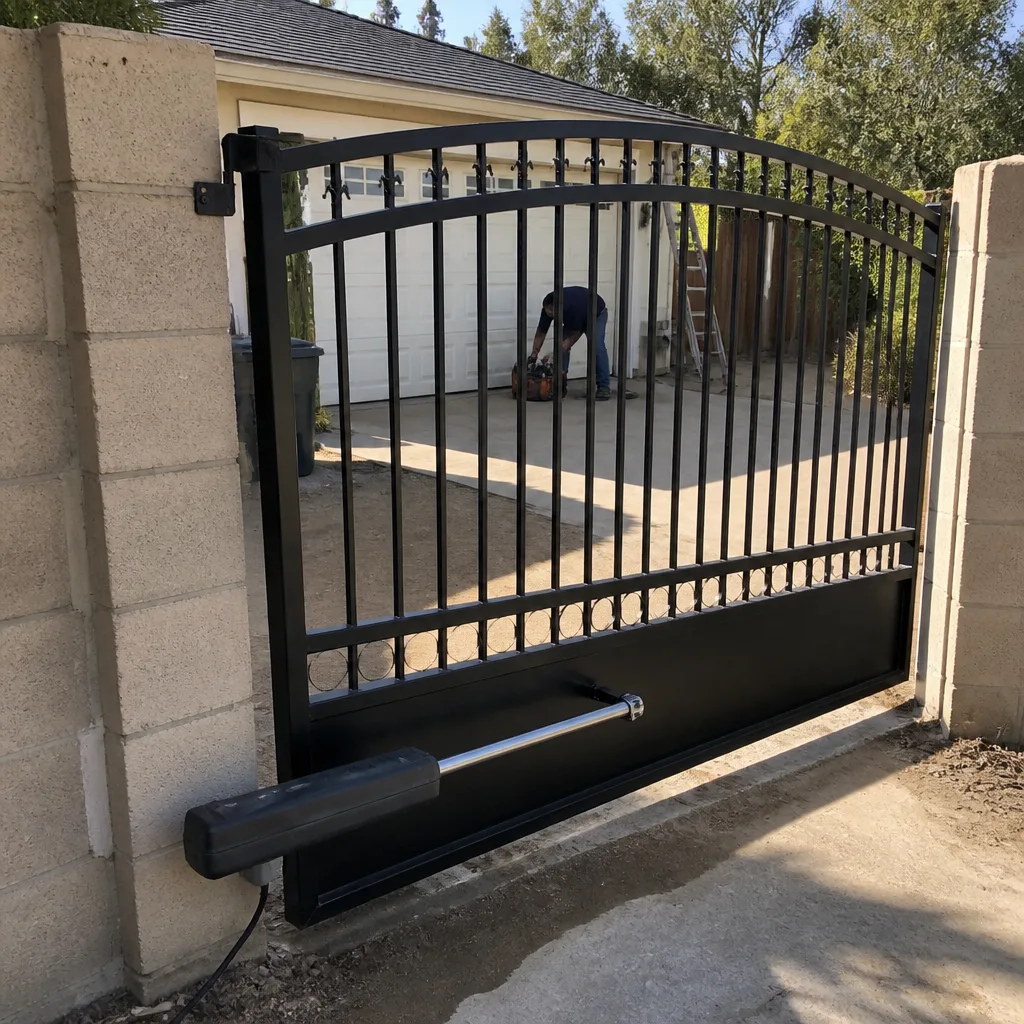 After
After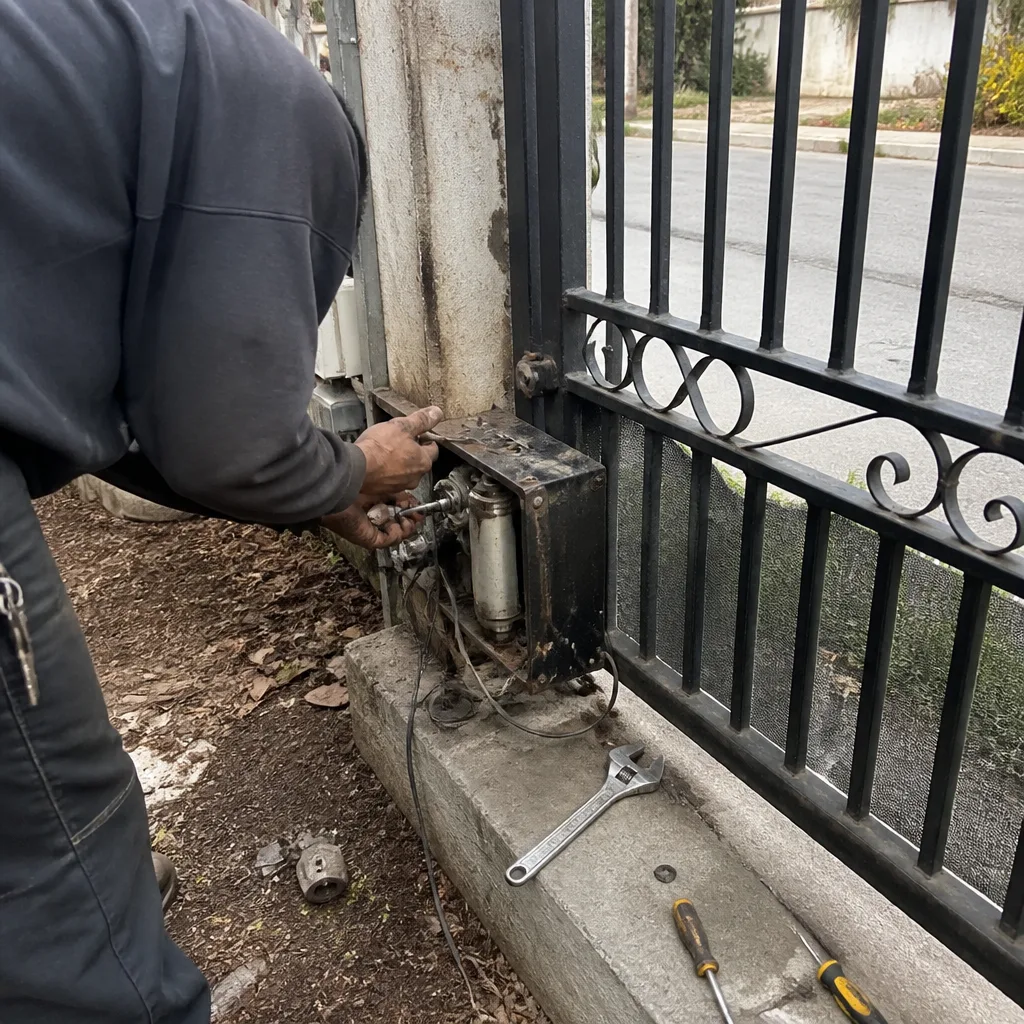 Before
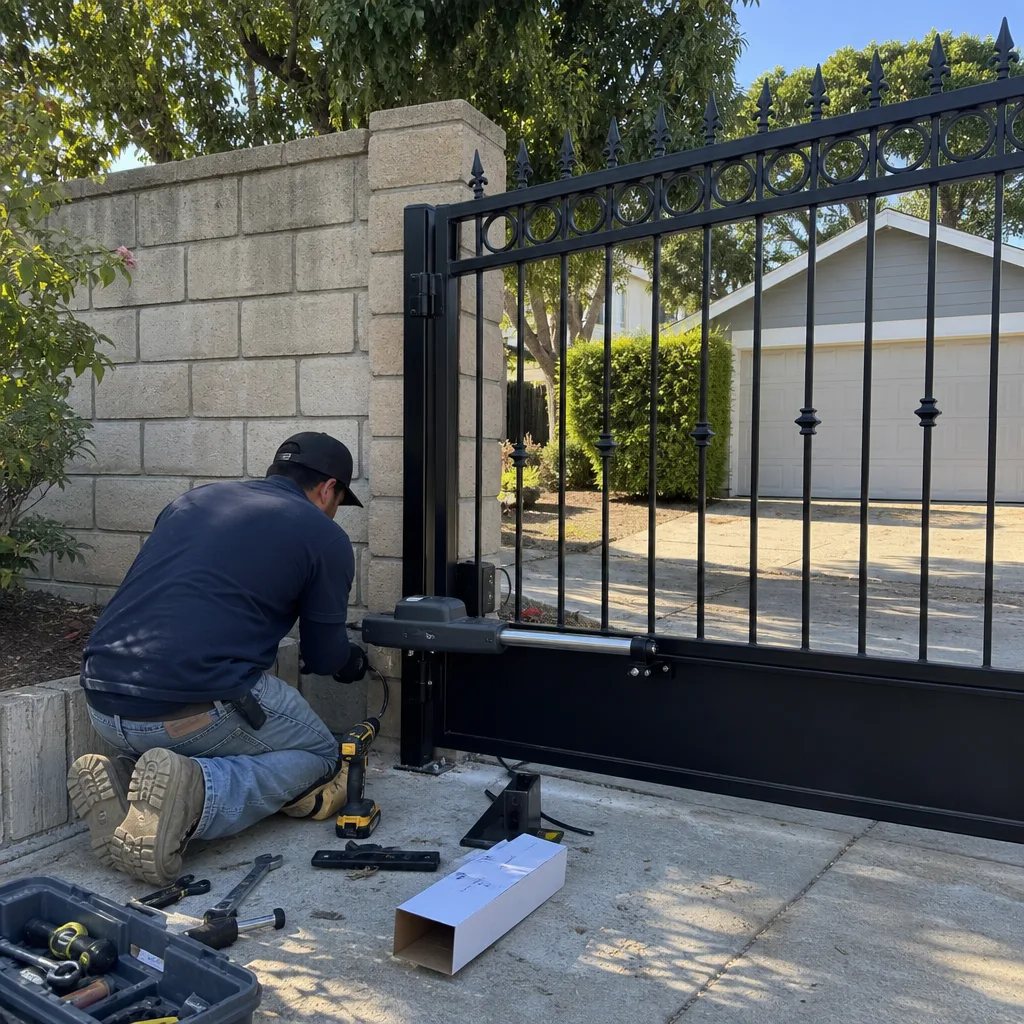 After
After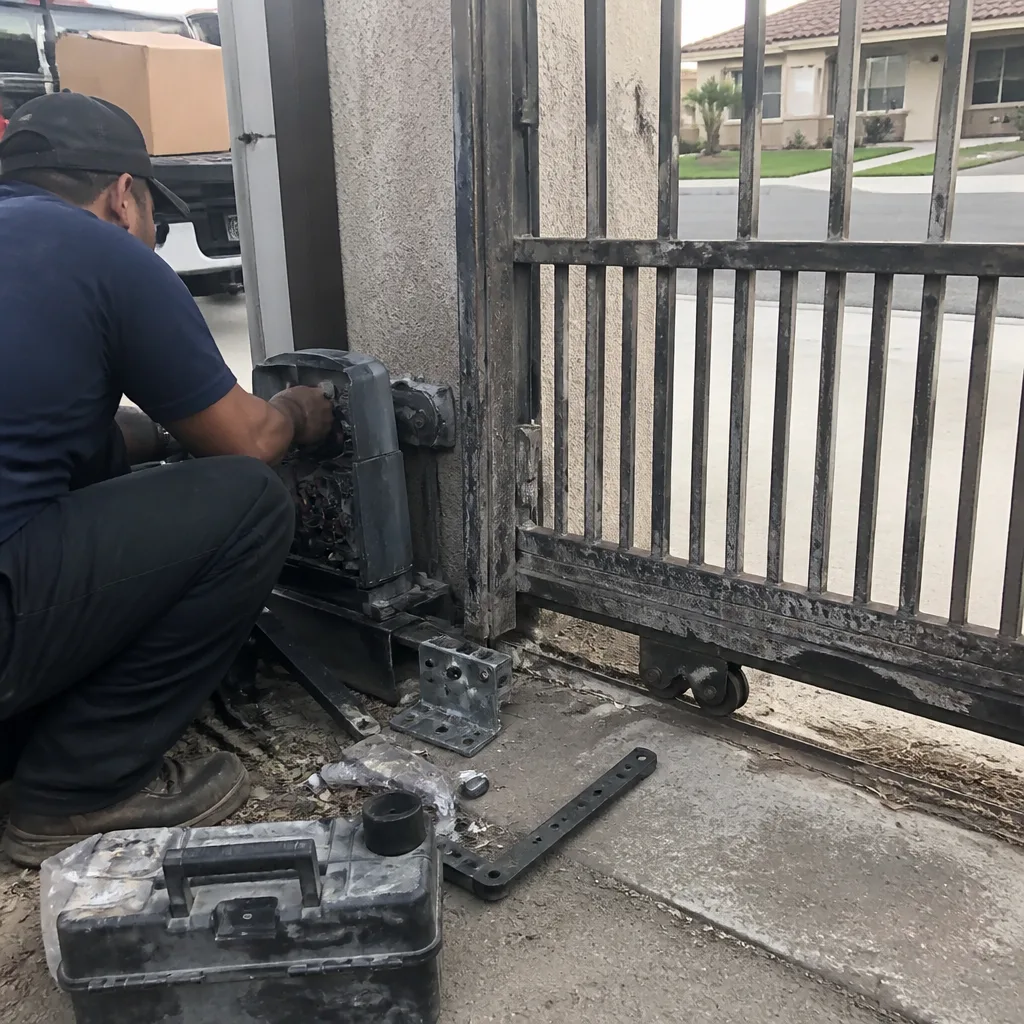 Before
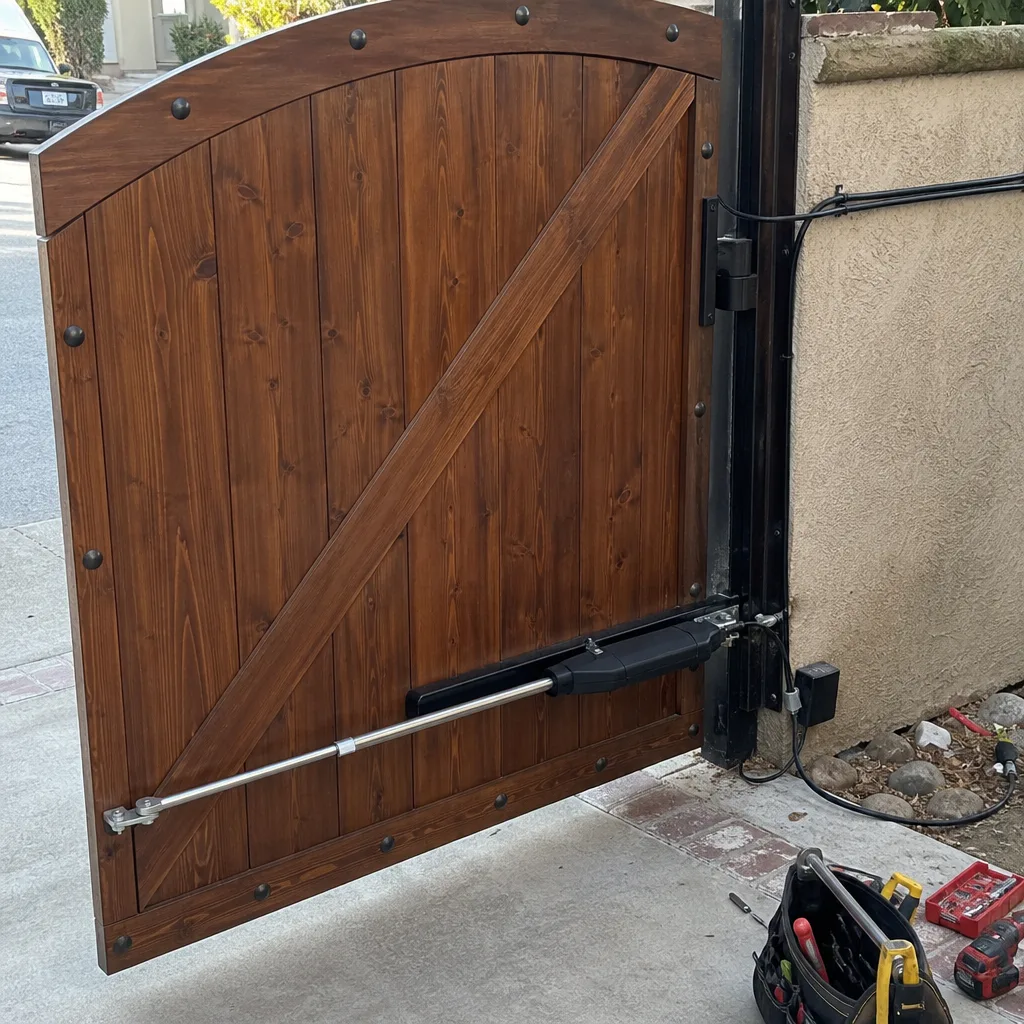 After
AfterGate Repair Warning Signs: A Riverside Homeowner’s Reference Guide
Here’s something most Riverside homeowners don’t know: a gate that grinds on the first open of the morning, then runs quietly by midday, isn’t a lubrication problem. It’s almost always a drive gear or chain that’s contracted overnight in cooler temperatures, and that contraction pattern is the gate announcing a failure that will arrive within 90 days. This guide maps every warning sign a gate gives off, in the order it gives them, and ties each one to the specific component failing, what it costs to fix now, and what it costs if you wait. If you live in Riverside, where summer afternoons routinely top 95°F, you’ll also learn which warnings are heat-specific and point at electronics rather than mechanics. For related reading, see our guide on Seasonal Gate Repair Care for Riverside: Year-Round Homeowner’s Guide.
Quick Answer
The warning signs of gate failure appear in a predictable sequence: noise first, then hesitation, then partial function, then full stop. Grinding that changes pitch or occurs only at certain temperatures points to the drive gear or chain. A gate that reverses once mid-travel is usually a force-sensitivity setting issue, but a gate that reverses repeatedly is a photo-eye or edge-sensor failure that creates entrapment risk. The cost difference between catching stage one and stage four is typically $150 versus $600 or more for a motor replacement.
Table of Contents
- The Four-Stage Warning Progression and What Each Stage Costs
- The Five Sounds a Gate Makes, and What Each One Names
- Heat-Specific Warnings: Why Afternoon Failures Point at the Board, Not the Motor
- Visual Warnings Homeowners Routinely Miss: Sag, Rust, and Heave
- Safety-Critical vs. Scheduled: When the Gate Cannot Wait
- What Each Stage Costs in Riverside Right Now
- What a Proper Gate Repair Should Leave Behind: The Documentation Standard
BeforeAfterThe Four-Stage Warning Progression and What Each Stage Costs
Gate failure announces itself in stages. We’ve documented thousands of gate failures across Riverside since 2014, and the progression is remarkably consistent. Here’s the sequence, the component responsible at each stage, and the realistic cost window for Riverside’s market if addressed at that point. If you’re considering professional help, read How to Hire a Gate Repair Contractor in Riverside: A Step-by-Step Guide.
- Stage One: Noise. Grinding, squealing, clicking, or a change in the gate’s normal operating sound. Component responsible: drive gear, chain tension, or a dry bearing. Cost now: $150 to $250 for gear adjustment, chain tensioning, or bearing lubrication and replacement.
- Stage Two: Hesitation. The gate pauses mid-travel, starts slowly, or stutters before completing its cycle. Component responsible: limit switch drift, capacitor degradation, or battery backup aging on swing operators. Cost now: $150 to $300 for limit switch reset or capacitor replacement.
- Stage Three: Partial Function. The gate opens but won’t close. The remote works from 20 feet but not 40. The keypad works, but the remote doesn’t. Component responsible: photo-eye misalignment, receiver board degradation, or a failing control board output. Cost now: $200 to $450 depending on the part.
- Stage Four: Full Stop. The motor hums but nothing moves. Or nothing happens at all. Component responsible: stripped drive gear, seized motor, or a dead control board. Cost now: $450 to $900 for motor replacement, $300 to $650 for a control board replacement.
The pattern holds across every gate brand we service, and it holds in Riverside specifically because our temperature swings accelerate the stage-one to stage-four timeline. A gate that grinds for a week in October can sit quiet for three months through winter, then strip its gear in the first week of a June heat wave. The staging matters because each stage has a specific, identifiable component. You don’t replace a motor at stage one, and you don’t adjust a limit switch at stage four. Catching the right stage means paying for the part that’s actually failing, not the part that failed because you waited.
The Five Sounds a Gate Makes, and What Each One Names
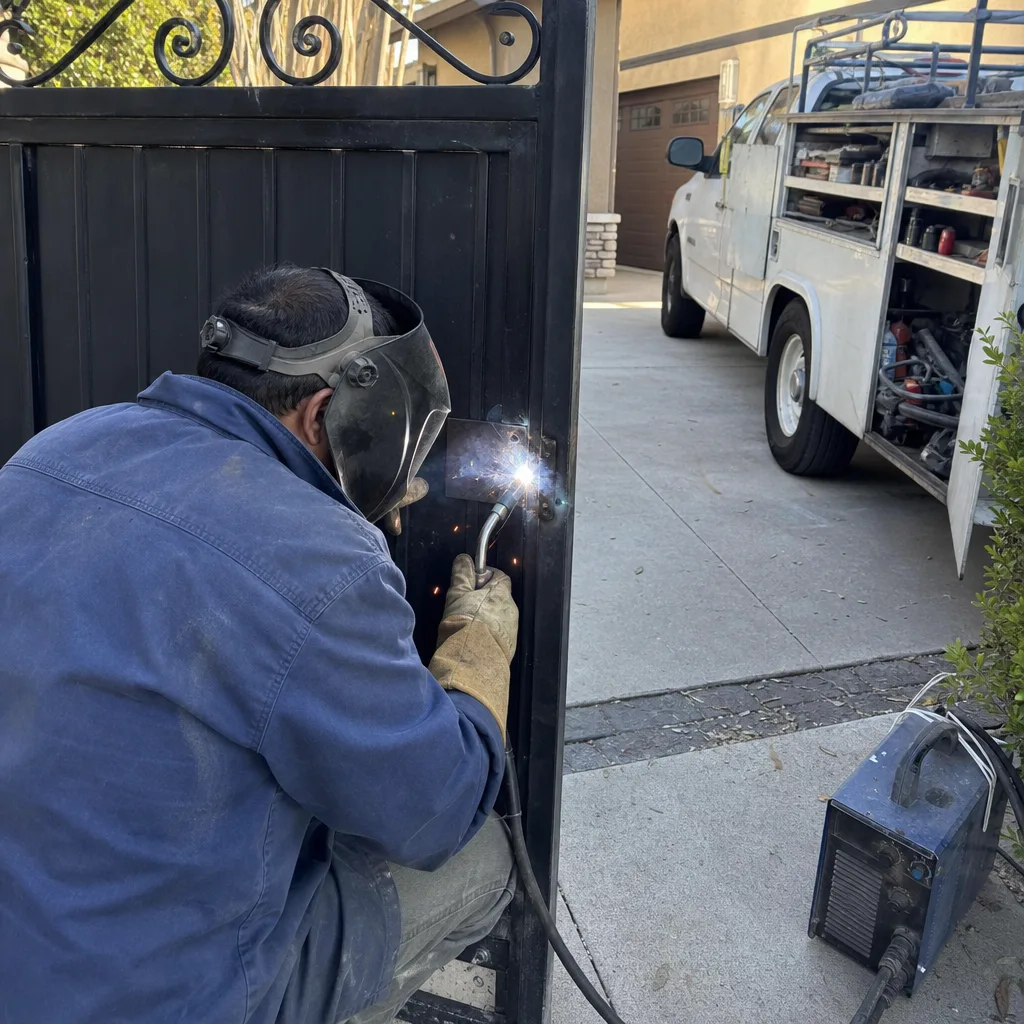
The pitch, timing, and location of a gate sound tells you more than the sound itself. Here are the five sounds we hear most often on Riverside gate service calls, mapped to the component each one indicates. The location matters: a sound from the motor housing and a sound from the hinge post are entirely different failures.
- Low grinding throughout travel, consistent pitch. This is the drive gear or the chain rubbing against the sprocket that has developed tooth wear. On a LiftMaster or DoorKing slide gate, this is the most common pre-failure sound. If the pitch is steady, the gear teeth are worn evenly and replacement is straightforward. If the pitch wavers, the gear is wobbling on its shaft, and delaying repair will damage the shaft itself, doubling the part cost.
- High-pitched squeal only during the first few seconds of travel. This is a dry bearing or a misaligned pulley. On Viking and Ghost Controls swing arm operators, the squeal frequently comes from the arm bushing at the point where the arm connects to the gate leaf. Lubrication is a temporary fix. Bushing replacement is the actual repair.
- Rapid clicking from the control box when you press the remote. This is the relay on the control board chattering. It means the board is getting power, the remote signal is arriving, but the output to the motor is failing. On Elite and FAAC boards, we see this when a capacitor is on its way out or when a solder joint on the board has hairline fracture.
- A thunk or clunk at the end of travel, right before the gate stops. The mechanical stop is making contact with the gate frame instead of the limit switch cutting power first. This means the limit switch has drifted or failed. Over time, that thunk takes a toll on the gear and the frame welds.
- A hum from the motor with zero gate movement. The motor is getting power and trying to run, but the drive assembly isn’t transferring motion. This is almost always a stripped drive gear on a slide gate, or a broken chain or belt on a swing gate. The motor may still be fine, but continuing to run it in this state will burn out the windings within days.
If you capture a short video or voice memo of the sound before you call us, that’s genuinely useful. On the phone with you at 2 a.m., a Riverside homeowner who can play me a 10-second recording of the sound gives me a head start on loadout. We handle a fair number of calls from Gate Repair in Riverside where we dispatch a technician with a drive gear and a limit switch because the sound narrowed it down before they ever turned a wrench. Sound documentation is free, and it saves you a second visit.
Heat-Specific Warnings: Why Afternoon Failures Point at the Board, Not the Motor
This is the warning sign most Riverside homeowners miss, because it doesn’t match the classic gate-failure pattern. A gate that works flawlessly in the morning and fails only on afternoons above 95°F is not a mechanical problem. It’s electronics. And the most likely culprits, in order of frequency on our Riverside service calls, are the control board, the motor capacitor, or a thermal overload switch that’s tripping too early.
Here’s what’s happening. Riverside’s summer ambient temperature on the gate motor housing can exceed 130°F on an afternoon with direct sun and no shade. That heat accelerates a failure on any control board with a marginal solder joint or a capacitor that’s drifted out of specification. The component works when it’s cool, expands when it’s hot, and the circuit opens. The gate reverses direction, stops mid-travel, or refuses to respond until the sun drops.
The pattern to look for:
- Time-specific failure. The gate fails only between roughly 1 p.m. and 6 p.m. in the summer months. Riverside’s peak ambient temperature window lines up with that failure window.
- Reset on cooling. The gate works again after sunset or early the next morning without anyone touching it. That’s thermal expansion closing a marginal connection.
- Remote and keypad both fail at the same time. When mechanical parts fail, you usually lose function at the gate but the remote still triggers the motor. When the control board fails on heat, every input goes dead because the board is the common path.
- The gate works when you open the control box lid. If manually venting the control box restores function within a few minutes, the issue is heat buildup inside the enclosure, not the gate itself.
Riverside’s specific climate means we see this failure mode from May through October. A homeowner who calls us in August with “the gate only works in the morning” is almost always looking at a capacitor replacement or a control board swap, not a new motor. The capacitor is the cheaper fix, typically $150 to $250 installed. The board is more, $300 to $650 depending on the brand. On a Ghost Controls or Viking swing arm, the capacitor replacement is a 30-minute job that a Riverside homeowner could watch us do and understand by the end.
Visual Warnings Homeowners Routinely Miss: Sag, Rust, and Heave
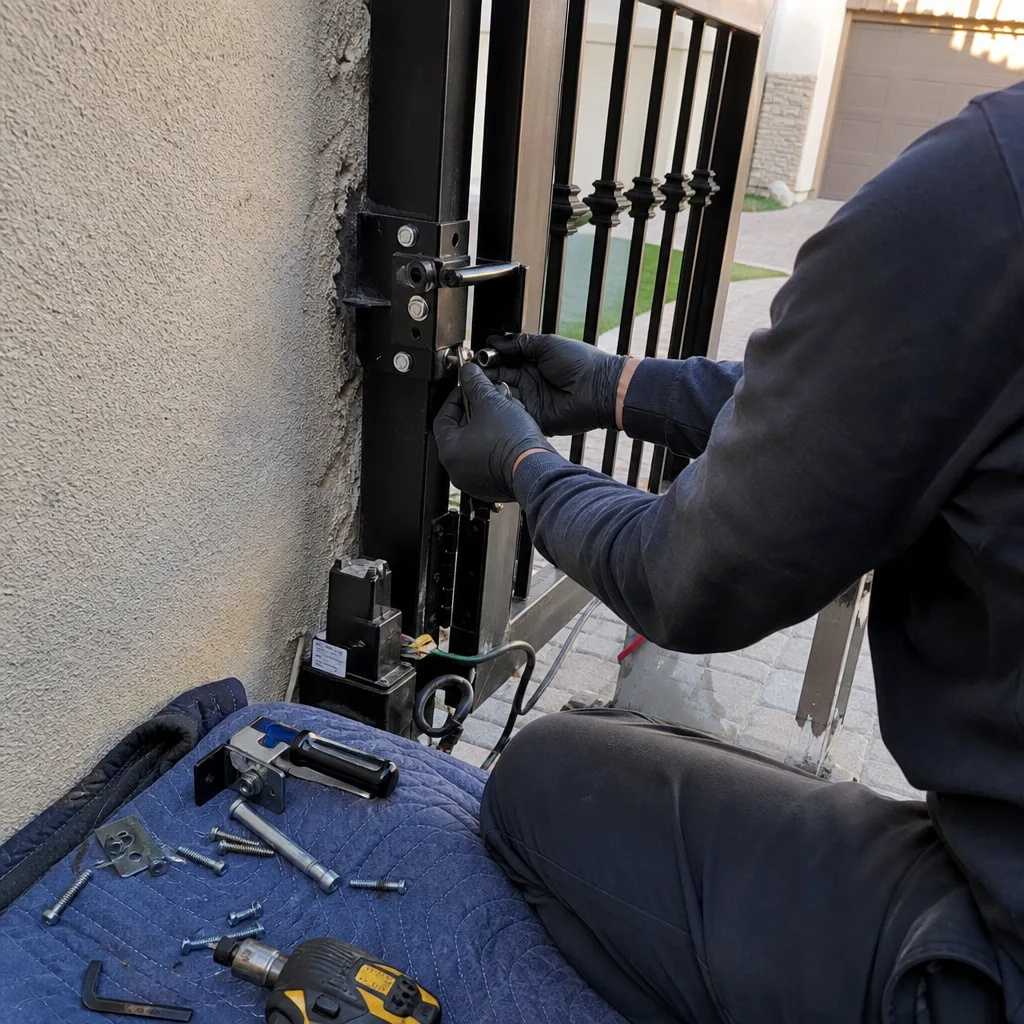
You don’t need to hear a gate to know it’s failing. There are three visual warnings that show up long before audible or functional problems, and Riverside homeowners routinely overlook them.
Gate sag: the half-inch threshold
A swing gate that has dropped more than half an inch at the latch side has a structural problem, not a cosmetic one. The sag means the hinge post has shifted, the hinge barrels have worn, or the gate frame welds are fatiguing. If you can lift the latch end of the gate and feel vertical play, you’re in the warning stage. Letting that sag continue means the gate will stop latching correctly, and the misalignment will put a point load on the operator arm that accelerates motor and gear wear. On a Viking arm operator, a sagging gate leaf is the number-one cause of premature arm bushing failure we see in Riverside.
Rust location patterns
Rust doesn’t ruin gates uniformly. It attacks specific points, and the location of the rust tells you what’s failing:
- Rust at weld joints and hinge plates. Structural concern. This is the connection point bearing the gate’s entire weight, and rust here means the joint is degrading internally, not just on the surface.
- Rust at the bottom rail, near the ground. Moisture wicking. This is more common on Riverside properties with irrigation overspray hitting the gate. The rust is cosmetic now, but it opens the steel to accelerated wear at the lowest structural point.
- Rust at bolt heads and fasteners. Fastener failure. Bolts that rust on the exterior are rusting in the threads too, and that means any future repair requires cutting them out, which adds time and labor to every job.
Concrete heave at post footings
Riverside’s soil has a high clay content in many neighborhoods, and clay expands and contracts with moisture far more than sandy or rocky soil. That movement causes concrete post footings to heave slightly, usually upward by a fraction of an inch. You’ll see a hairline crack at the base of the post where the concrete meets the post steel, or a visible gap between the soil and the footing edge. The post is moving. When the post moves, the gate’s alignment shifts, the operator arm fights a changing geometry, and the limit switches that were set to travel a specific distance no longer match the actual gate travel. It all cascades from a tiny footing movement. If you see the crack, the fix is re-seating or re-pouring the post footing, which is a concrete job, not a gate part replacement. Catching it early is a few hundred dollars. Missing it until the post has shifted a full inch is a re-hang, a footing replacement, and sometimes a new gate leaf.
Safety-Critical vs. Scheduled: When the Gate Cannot Wait
Most gate warnings can wait a few days for a scheduled appointment. A grind can wait, a sag can wait, a dead remote can wait. But there are four warnings that should be addressed same-day, because they indicate an active entrapment hazard or a gate that can move unpredictably. These are the conditions where continuing to run the gate risks injury to a person or a pet. The danger is real: a swing gate edge exerts enough force at mid-travel to break a limb, and a slide gate can pin a child against a post.
- Repeated mid-travel reversals. A gate that reverses once, then completes its cycle on the second attempt, is usually a force-sensitivity setting reacting to wind or minor drag. A gate that reverses every time, at the same point, is a photo-eye or edge-sensor that has failed, which means the gate is now operating without its safety monitoring at that point. The gate thinks something is in the path when nothing is there, which means it will also think nothing is in the path when someone actually is. Same-day response.
- Gate continues to close with the photo-eye beam blocked. This is the inverse of the above and it’s worse. The photo-eye has failed open, meaning the safety circuit is no longer stopping the gate. If you can block the beam with your hand and the gate continues to close, do not operate the gate until the photo-eye is replaced. Same-day response, and we’d tell any Riverside homeowner not to run that gate manually until the edge sensor is also verified.
- Sparks, smoke, or a burning smell from the control box. If you see any of these, cut power at the breaker or the power switch on the operator, and leave it off. This is not a repair, it’s a safety shutdown. The smoke is insulation burning off windings or a board component reaching failure temperature. Same-day response, and cut power now.
- The gate drifts open after being closed, or creeps closed without a command. A gate that moves on its own has either a hydraulic leak in the drive system (if hydraulic), or a control board issuing phantom commands, or a gear that has stripped to the point where the gate’s own weight overcomes the brake. The gate is no longer under command. Treat it as actively dangerous. Same-day response.
These four conditions are the ones we prioritize on our Riverside schedule. A 2 a.m. phone call about a gate that creeps closed gets a live person on the line, and if the condition warrants it, a technician dispatched that night. The thresholds are not negotiable: if the gate can move a person, the gate is a safety system, not a convenience.
What Each Stage Costs in Riverside Right Now
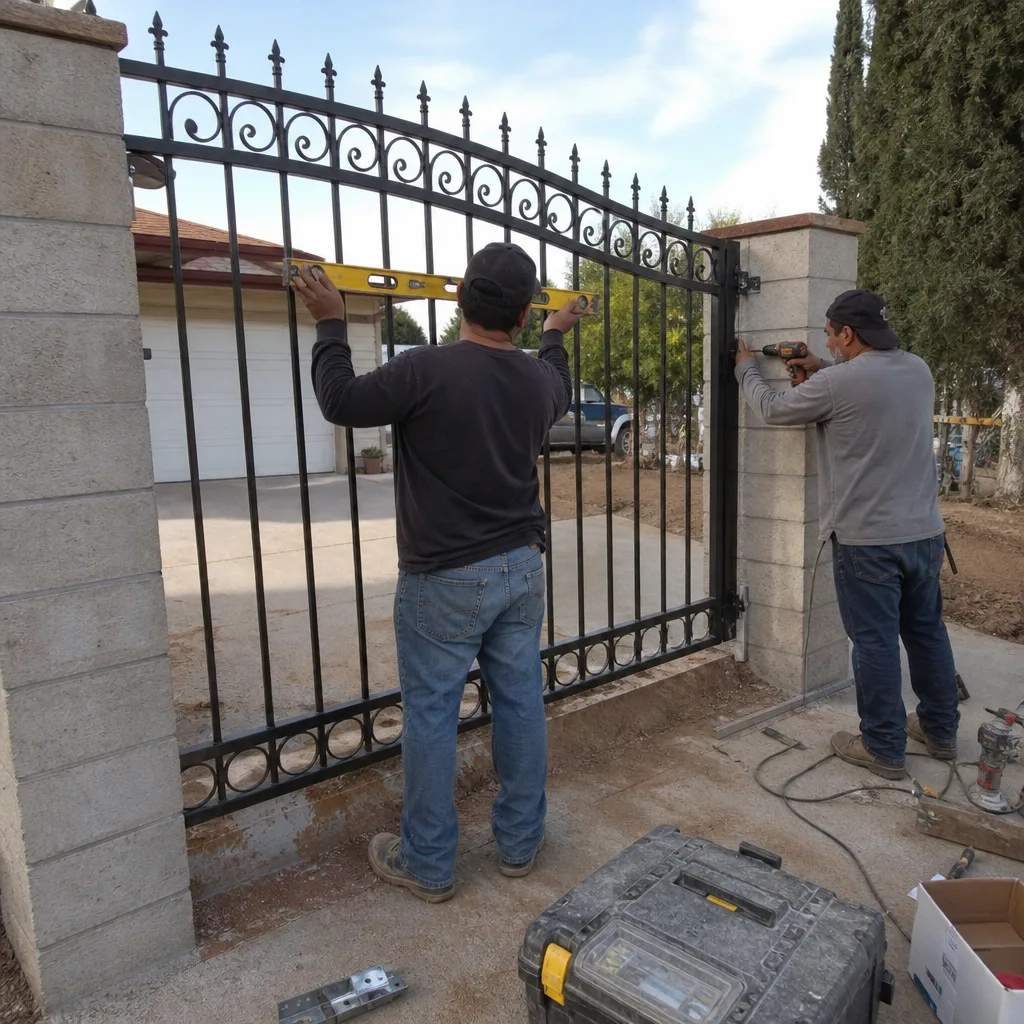
We write prices before we touch a gate, so here are the current cost windows for the most common repairs, specific to Riverside’s market as of 2026. These are the prices you’ll see on a written estimate, not a verbal range on the phone. The variables that move the price within the window are brand, gate weight and length, and whether the existing bracket and mounting hardware are intact or need replacement.
| Repair | Stage | Cost Range | What Moves the Price |
|---|---|---|---|
| Drive gear replacement (slide gate) | Stage one, if caught early | $150 - $250 | Gate weight, gear material, whether the shaft is undamaged |
| Chain tensioning and alignment | Stage one | $120 - $200 | How far the chain has stretched, sprocket wear |
| Limit switch reset or replacement | Stage two | $150 - $300 | Switch type, whether it’s integrated into the operator arm |
| Capacitor replacement | Stage two | $150 - $250 | Capacitor rating, access difficulty |
| Photo-eye realignment or replacement | Stage three | $130 - $350 | Realignment vs. replacement, wiring condition |
| Control board replacement | Stage three or four | $300 - $650 | Brand, board revision, whether the old board is still made |
| Motor replacement (swing or slide) | Stage four | $450 - $900 | Brand, motor type, whether the arm bracket is reusable |
| Gate re-hang and hinge repair | Visual warning stage | $250 - $600 | Gate size, hinge type, whether the post is sound |
| Post footing re-seat | Visual warning stage | $300 - $800 | Concrete volume, access, whether the gate must come off |
These are the numbers. The price is written, handed to you, and agreed before anyone picks up a tool. That’s the entire point of Vance Gate Repair Riverside home pricing: the estimate you read on the page is the price statement you get before work starts. No verbal range that shifts later, no discovery invoice at the end.
What a Proper Gate Repair Should Leave Behind: The Documentation Standard
Here’s the part of a gate repair that most Riverside homeowners don’t know to ask for: the documentation. A proper gate repair leaves a record. Not a cryptic invoice line that says “gate service,” but an actual record of what was found, what was changed, and what the readings were when the tech left.
We do this on every job because Adrian Vance started in commercial access control in 2014, where a gate failure on a controlled site requires a written log, a wiring diagram, and photographic evidence. When he started doing residential gate work, he kept the habit. The residential gate industry mostly doesn’t do this, but it should. Here’s what the record we leave on a repair should include, and what you should ask for from any gate company:
- Written scope before the work. A flat price, in writing, listing exactly what will be repaired and what it costs. Not an estimate with a plus-minus, not a verbal number. We hand it over before the first tool comes out.
- Photo log of findings. Pictures of the worn gear before removal, the limit switch setting before and after adjustment, the control board wiring before any changes. You get these photos. They go in your file so that if anything happens in month nine, the technician knows exactly what was done in month one without guessing.
- Part numbers and readings on the record. The actual part number installed, the actual limit switch position in degrees, the actual force setting on the operator, and the actual photo-eye beam voltage reading. If the gate falls out of spec later, the documentation shows the baseline.
- A copy left with the homeowner. Not a portal link that expires, not a text message. A written or emailed record that stays with you, so any future technician from any company can read what was done and not pay to rediscover it.
This is the single biggest difference between a $150 adjustment that lasts and a $600 motor replacement that shouldn’t have happened. A proper record means the next technician starts from facts, not from symptom-guessing. It’s the same reason we do Gate Motor & Opener in Riverside work with a written diagnostic before any parts order: the motor should be replaced because the motor is actually dead, not because the limit switch was set wrong and nobody documented the previous repair.
Common Mistakes to Avoid

- Greasing a grinding gear. If the gate grinds, lubricant will quiet it for a day or two, which is the worst possible outcome: you now have a failing gear that doesn’t warn you anymore. The gear is metal-on-metal worn. Grease isn’t the fix; replacement is.
- Ignoring a once-a-day reversal as “the wind.” Riverside gets Santa Ana winds, and wind can absolutely trigger a force-sensitivity reversal. But if the reversal happens on calm days at the same point in travel, it’s not the wind. It’s the photo-eye or edge sensor, and that’s a safety circuit telling you it’s failing.
- Replacing remotes when the receiver is the problem. We see this regularly: a homeowner buys two new remotes, they program them, the gate still only works from 10 feet. The receiver board in the control box has degraded. The remotes were never the problem.
- Letting a sagging gate run “a little longer.” Every cycle a sagging gate makes is putting asymmetric load on the operator arm, the hinge barrels, and the motor. A $250 re-hang now is a $700 motor and gear job in six months.
- Rust-painting without treating the steel. If you see surface rust and hit it with a can of spray paint, you’ve sealed moisture against the steel and accelerated the internal corrosion. Rust treatment requires wire brushing, a rust converter, then primer, then paint. The paint alone does nothing.
- Assuming a dead gate in summer means a dead motor. In Riverside’s heat, a gate that fails only on hot afternoons and comes back at night is a thermal electronics issue, not a motor failure. Replacing the motor won’t fix a capacitor that only fails above 90°F.
When to Call a Professional
Call when the warning sign is a safety risk, and call when the warning sign is audible enough to record with your phone. Those are the two thresholds. The grinding gear, the sagging leaf, the photo-eye that intermittently reverses, the post that’s heaving: these are all professional repairs, not weekend projects. A gate that weighs 600 pounds moving on a motorized arm carries enough force to injure or entrap, and the components that fail are under tension or under load without looking like they are. We’re not going to give DIY instructions for a swing arm under spring tension or a slide gear under drive load, because the injury risk is real. What we will do is look at the gate, name the component, write the price before we start, and leave you with a photo and part-number record of everything done. That’s the standard. If you’re in Riverside, Vance Gate Repair Riverside offers free estimates on any gate warning sign described in this guide. Call (951) 934-7330 and a person answers, at any hour, day or week.
Frequently Asked Questions
Most gate repairs in Riverside cost between $120 and $900, depending on the stage of failure. A drive gear adjustment or chain tensioning at the early warning stage runs $120 to $250. A motor replacement at full failure runs $450 to $900. A control board replacement falls between those at $300 to $650. Call (951) 934-7330 for a written quote on your specific gate, and the price we hand you before work starts is the price you pay.
A gate that fails only on Riverside afternoons above 95°F and comes back after cooling is an electronics problem, not a mechanical one. The heat expands a marginal solder joint on the control board or pushes a capacitor out of spec until the circuit opens. The fix is a capacitor replacement ($150 to $250) or a board swap ($300 to $650), depending on what the testing shows.
For safety-critical issues like a gate that reverses itself repeatedly, drifts closed on its own, or emits smoke or a burning smell, yes. We dispatch same-day for entrapment-risk conditions, and a live person answers the phone 24/7 to assess what you’re seeing. For non-safety issues like grinding or sag, we schedule at your convenience and complete the repair on the written schedule.
A full installation includes the gate leaf or leaves, the operator and arm, the safety photo-eyes and edge sensors, the control board, all wiring from the power source, and the limit switch calibration. The price on a new installation is written and handed to you before any work begins. See Gate Installation in Riverside for the full breakdown.
Yes. The power run from the breaker to the operator, the low-voltage wiring for the photo-eyes and edge sensors, and the edge sensor installation itself are all part of the job, quoted in the written scope before work starts. Every installation includes the documented record of wiring and settings when we’re done.
Yes, that’s an early failure warning, not a lubrication issue. The grinding that fades as the day warms is a drive gear or chain that has contracted overnight and is signaling that the gear teeth are wearing past tolerance. In our Riverside experience, that gate has about 90 days before the grinding becomes constant or the gear strips entirely. The early fix is $150 to $250; the late fix is a motor replacement at $450 to $900.
The Bottom Line
A gate doesn’t fail without warning. It fails in a sequence: noise, hesitation, partial function, full stop. Each stage has a named component behind it, and each component has a Riverside repair cost that sits in a predictable window. The $150 adjustment and the $600 motor replacement are the same failure caught at different points. In Riverside’s heat, the warnings get harder to read because thermal electronics failures mimic mechanical ones, but the pattern is identifiable if you know that an afternoon-only failure is a board problem, not a motor problem. Check for sag, check for rust, listen for the grinding, and when you hear it or see it, act. The gate tells you what’s wrong. It’s just that most people don’t know the language. For more guides & resources, visit our blog.
Written by Adrian Vance, Owner at Vance Gate Repair Riverside, serving Riverside since 2014.